
Choosing a dependable Organic Sweet Potato Powder supplier requires more than comparing prices or attractive product photos. In practical sourcing, small details often decide whether a powder performs well. Color, aroma, mesh size, moisture content, and solubility can change between batches. A bright orange powder may suggest careful processing, but appearance alone proves little. Reliable buyers should request current certificates, laboratory reports, allergen statements, and traceability records before placing an order.
This guide reviews the Top 10 Organic Sweet Potato Powder Suppliers in 2026 through a practical, evidence-focused lens. The comparison considers organic certification, raw material origin, processing standards, quality control, packaging options, minimum order quantities, and export experience. Supplier communication also matters. Clear answers about harvest seasons and lead times can prevent costly production delays. Ask direct questions.
Some rankings may change as certifications expire, factories expand, or new suppliers enter the market. That limitation deserves attention. Public information is not always complete, and supplier websites may present only their strongest advantages. Therefore, this list should support due diligence, not replace it. Buyers should confirm certificates with issuing bodies and evaluate samples under real production conditions. A powder used in smoothies may behave differently in bakery fillings or nutritional blends. Taste, color stability, and water absorption should be tested before approval.
The selected companies represent different strengths, from flexible private-label services to larger-scale manufacturing capabilities. Their suitability depends on your application, budget, market, and compliance requirements. Careful verification remains essential. The best supplier is not always the cheapest. It is the one that consistently delivers safe, traceable, and fit-for-purpose powder.
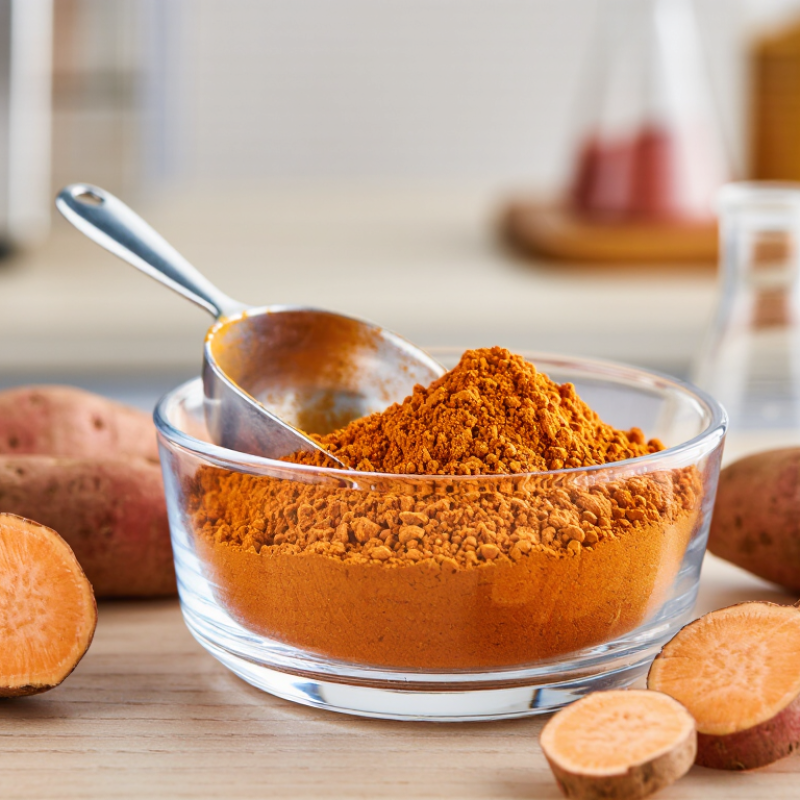
Organic sweet potato powder is made by washing, slicing, drying, and milling certified organic sweet potatoes. It retains a naturally orange color, mild sweetness, and useful starch content. USDA organic rules require approved production methods and controlled handling throughout the supply chain. Certification still matters. “Natural” does not automatically mean organic.
FAOSTAT data places global sweet potato production above 86 million metric tons in 2022. This large crop supports growing interest in stable, shelf-ready ingredients. Industry analyses from Grand View Research also report continued expansion in organic food and beverage demand, although powder-specific estimates vary between reports. That difference deserves attention.
Manufacturers use the powder in bakery mixes, noodles, soups, smoothies, infant foods, and snack coatings. It can add body and color without artificial dyes. In a bakery trial, the powder may replace part of wheat flour, but excess use can create a dense crumb. That is a common mistake. Start with small inclusion levels.
The powder also offers practical storage benefits. It weighs less than fresh roots and needs no peeling during daily production. Yet heat exposure, moisture, and poor packaging can reduce flavor quality.
Buyers should check organic certification, moisture content, microbiological testing, particle size, and country of origin.
USDA FoodData Central lists raw sweet potatoes at roughly 3 grams of dietary fiber per 100 grams, but processing changes the final nutrition profile. Always verify the finished product’s laboratory analysis.

Top 10 Organic Sweet Potato Powder Suppliers in 2026
Key Standards for Evaluating Organic Powder Suppliers
When comparing organic sweet potato powder suppliers, certification should be the starting point, not the final decision. Check whether the certificate covers the actual product, processing site, and current production period. Reliable suppliers should provide traceability from farm records to finished-batch documentation. Ask for recent laboratory reports covering pesticide residues, heavy metals, microbial safety, moisture, and foreign matter. A clear certificate of analysis should match the batch number on the packaging.
Processing details also reveal practical expertise. Confirm the drying method, powder mesh size, color range, and storage conditions. Excessive heat may reduce natural color or affect flavor. Moisture control matters because damp powder can cake during transport. Suppliers should explain allergen controls, cleaning procedures, packaging materials, and recall processes. I have found that polished documents can still hide weak communication. Delayed answers are not proof of poor quality, but they deserve attention.
Tips: Request samples from different batches. Compare aroma, color, solubility, and sediment after mixing. Review audit dates, not only audit logos. Confirm production capacity before signing a supply agreement. Ask how seasonal crop changes affect consistency. A low price may reflect lower testing frequency or thinner traceability. That is not always true, but it requires evidence. Also, evaluate response time and technical support. These details often predict how smoothly quality issues will be handled.
A credible organic sweet potato powder supplier should be able to demonstrate that the finished product contains at least 95% certified organic agricultural ingredients when making an organic claim under the major certification systems shown below. Buyers should also verify certificate validity, ingredient traceability, processing controls, and batch-level documentation.
Reference standards: USDA National Organic Program, European Union Organic Regulation, Japanese Agricultural Standard for Organic Products, Canada Organic Regime, and China Organic Product Standard. Water and salt are generally excluded from the organic ingredient calculation.
The top organic sweet potato powder suppliers in 2026 should prove more than attractive pricing. Buyers need traceable farms, validated organic certification, and stable processing controls. FAOSTAT reported global sweet potato production near 89 million tonnes in 2022. That scale supports supply, but it does not guarantee powder quality.
The FiBL and IFOAM 2024 industry report valued the global organic market at about €135 billion in 2022. The Organic Trade Association also reported US organic sales of $67.6 billion in 2023. These figures indicate stronger demand for clean-label ingredients. However, sweet potato powder market estimates vary widely between commercial reports. That inconsistency deserves attention. A reliable supplier should provide current certificates, pesticide-residue tests, moisture results, microbiological reports, and batch-level traceability. Experienced buyers should also examine color, sweetness, mesh size, and dispersibility. One overlooked detail can affect an entire production run.
Tips: Request a recent sample before signing a contract. Test it in your actual recipe. Ask whether drying temperatures protect color and nutrients. Confirm the crop year, country of origin, packaging barrier, and minimum order quantity. Suppliers with transparent answers usually reduce operational risk. Still, documentation can be incomplete, and audits are not perfect. Independent verification remains worthwhile.
For the Top 10 Organic Sweet Potato Powder Suppliers in 2026, quality starts with the raw crop, not the package. FAOSTAT reported global sweet potato production above 88 million tonnes in 2022. That scale can hide major differences in soil control, variety, and drying practice. Strong suppliers provide harvest records, pesticide testing, moisture data, and clear country-of-origin details. Ask for a recent certificate of analysis. A glossy brochure is not enough.
Certifications separate serious suppliers from convenient traders. USDA Organic or EU Organic certification supports production claims, while ISO 22000, FSSC 22000, or BRCGS strengthens food-safety controls. Organic certification does not automatically prove low microbial risk. Testing should cover Salmonella, E. coli, yeast, mold, heavy metals, and pesticide residues. FiBL and IFOAM reported global organic retail sales of about €135 billion in 2022, showing strong demand for verified ingredients. Still, certification scope can be misunderstood. Check whether it covers processing and the exact powder facility.
Pricing usually reflects moisture, color, mesh size, packaging, order volume, and crop season. In procurement comparisons, lower quotes may exclude testing, freight, or organic segregation. Request pricing per kilogram on identical specifications. A useful benchmark includes sample approval, batch consistency, lead time, and replacement terms. My practical concern is simple: some suppliers publish impressive certifications but weak technical sheets. That should reduce confidence. The best comparison is not the cheapest offer; it is the clearest evidence behind every claim.
When comparing the top 10 organic sweet potato powder suppliers in 2026, verify certification before discussing price. Ask for current organic certificates, scope documents, and the certifying body’s contact details. A certificate alone is not enough. Confirm that it covers processing and export activities.
Request a detailed specification sheet. It should state moisture, mesh size, color, flavor, microbiological limits, and allergen controls. Ask how the supplier manages soil residues, pesticides, heavy metals, and foreign materials. Independent laboratory reports should match the actual production batch. Samples matter. Test the powder in your recipe, not only in a glass of water. Baking can reveal darker color, bitterness, or poor dispersion. This step is often skipped.
Traceability shows operational maturity. The supplier should identify the farm region, harvest period, drying method, and lot number. Check minimum order quantities, lead times, packaging strength, storage conditions, and shipping documents. A responsive technical team is valuable when specifications change. Still, do not confuse fast replies with reliable production. Request references or audit records where possible. A low quotation may hide inconsistent batches or expensive delays. I have found that supplier comparisons become clearer when every offer uses the same specification sheet. No process is perfect. Even careful buyers can overlook seasonal variation, so keep a retained sample and review each incoming lot.
| Rank | Anonymous Supplier Profile | Primary Supply Region | Organic Certification Coverage | Typical Product Specification | Available Formats | Indicative MOQ | Typical Lead Time | Quality & Compliance Documents | Best Fit |
|---|---|---|---|---|---|---|---|---|---|
| 1 | Supplier Profile 01 | United States | USDA Organic Food Safety System | 100% organic sweet potato; fine powder; moisture typically ≤8%; no artificial colors | Fine powder, conventional mesh, private-label packing | 500 kg | 4–8 weeks | Certificate of Analysis, allergen statement, pesticide-residue testing, microbiological report | U.S. food manufacturers and clean-label brands |
| 2 | Supplier Profile 02 | European Union | EU Organic IFS or BRCGS | Organic sweet potato powder; moisture typically ≤7%; controlled color and particle size | Industrial bulk bags, retail pouches, custom milling | 300 kg | 5–9 weeks | Organic transaction records, COA, heavy-metal testing, pesticide screening, traceability records | European processors and premium retail products |
| 3 | Supplier Profile 03 | China | EU Organic USDA Organic HACCP | Organic sweet potato powder; moisture typically ≤8%; 80–100 mesh options available | Bulk powder, customized mesh, OEM packaging | 1,000 kg | 3–7 weeks | COA, HACCP documentation, pesticide and microbiological testing, production traceability | High-volume importers and cost-sensitive manufacturers |
| 4 | Supplier Profile 04 | Peru | USDA Organic EU Organic | Organic orange or purple sweet potato powder; moisture typically ≤8%; naturally colored | Standard powder, purple sweet potato powder, food-service packs | 500 kg | 6–10 weeks | Organic certificate, origin statement, COA, heavy-metal and pesticide-residue reports | Functional-food, bakery, beverage and natural-color applications |
| 5 | Supplier Profile 05 | Japan | JAS Organic ISO 22000 | Organic sweet potato powder; moisture typically ≤7%; fine texture for beverage and confectionery use | Fine powder, small retail packs, food-service formats | 100 kg | 6–12 weeks | JAS certificate, COA, allergen declaration, microbial testing, packaging specifications | Premium products and smaller specialty launches |
| 6 | Supplier Profile 06 | South Korea | Korean Organic HACCP | Organic sweet potato powder; moisture typically ≤8%; mild natural sweetness and low additive profile | Fine powder, bakery-grade powder, customized consumer packs | 200 kg | 5–9 weeks | Organic certificate, COA, origin documentation, pesticide and microbiological reports | Asian retail, bakery and health-food manufacturers |
| 7 | Supplier Profile 07 | Thailand | EU Organic USDA Organic GFSI-recognized system | Organic sweet potato powder; moisture typically ≤8%; tropical-origin supply and export packaging | Bulk powder, drum packing, private-label formats | 500 kg | 4–8 weeks | COA, organic certificate, export documentation, pesticide-residue and microbial testing | Export-oriented brands and ingredient distributors |
| 8 | Supplier Profile 08 | India | NPOP Organic USDA Organic HACCP | Organic sweet potato powder; moisture typically ≤8%; customizable particle size | Bulk powder, sachets, retail pouches, OEM packing | 250 kg | 5–10 weeks | Organic certificate, COA, allergen statement, heavy-metal and pesticide testing | Private-label projects and mixed-volume purchasing |
| 9 | Supplier Profile 09 | Vietnam | EU Organic USDA Organic FSSC 22000 | Organic sweet potato powder; moisture typically ≤8%; export-grade processing and packaging | Fine powder, bulk bags, customized packaging | 500 kg | 4–9 weeks | COA, FSSC documentation, organic certificate, microbial and pesticide-residue reports | Regional distributors and food-ingredient importers |
| 10 | Supplier Profile 10 | Australia or New Zealand | Australian Certified Organic or equivalent HACCP | Organic sweet potato powder; moisture typically ≤8%; strong traceability and clean-label positioning | Bulk powder, food-service packs, premium retail packaging | 250–500 kg | 6–12 weeks | Organic certificate, COA, traceability statement, allergen declaration, contaminant testing | Premium nutrition, baby-food and clean-label applications |
Procurement note: MOQ, lead time, certification scope, moisture level and testing requirements are indicative sourcing benchmarks. Confirm current certificates, specifications, crop year, allergen controls, shelf life, incoterms and laboratory results directly with each supplier before placing an order.
© 2025 EXCELSIUS MEDICAL All rights reserved
Taiwan Office
2F., No. 18, Ln.31, Sec.1, Huandong Rd.,
Xinshi Dist., Tainan City 744, Taiwan, R.O.C.
German Office
Zeppelinstr. 4, Haus 3&4,
D-85399 Hallbergmoos, Germany
