10 Best Leading Lighting Manufacturers for Global Buyers

Lighting is no longer a small specification choice. It affects energy use, comfort, maintenance, and the appearance of a space. The International Energy Agency has estimated that lighting accounts for about 15% of global electricity consumption and around 5% of global greenhouse gas emissions. These figures are broad estimates, and actual shares vary by region and building type. Still, they show why buyers compare more than price.

This guide to 10 Best Leading Lighting Manufacturers for Global Buyers considers product range, technical capability, documented quality practices, customization, and after-sales support. The U.S. Department of Energy’s 2020 U.S. Lighting Market Characterization offers useful context: its analysis tracks how LED adoption is changing the nation’s installed lighting stock and energy use. For global procurement, however, a strong catalog is only part of the picture. Buyers should also examine photometric data, driver compatibility, warranty terms, lead times, and the availability of replacement components. Small details matter.

A manufacturer may look impressive in a brochure yet prove less responsive during installation. That gap is easy to overlook. No ranking can fully capture local service quality or project-specific performance, and supplier claims deserve verification. The companies discussed here are therefore starting points for due diligence, not automatic endorsements. By weighing evidence alongside practical experience, global buyers can identify Leading Lighting partners suited to their projects, budgets, and operating conditions.
10 Best Leading Lighting Manufacturers for Global Buyers

How the Global Lighting Manufacturing Industry Is Organized

The global lighting manufacturing industry is not one factory serving every need. It is a network of component suppliers, product assemblers, engineering teams, and regional distribution partners. Component makers supply drivers, LEDs, housings, lenses, and control systems. Manufacturers then combine these parts into fixtures for homes, offices, streets, or industrial sites. Some companies focus on high-volume production, while others handle custom designs and smaller orders. It is not simple. A polished fixture may depend on parts sourced from several countries, so production schedules can shift when one component is delayed.

Manufacturers also differ in how they manage design, testing, and after-sales support. A buyer comparing suppliers should ask who controls product design, where final assembly takes place, and how samples are checked against production units. Details matter. A warm-looking sample in a showroom does not prove that every batch will have the same color or brightness. Requesting test records, clear product specifications, and a written process for handling defects can make comparisons more reliable. Still, paperwork alone has limits; factory communication and consistent follow-through are worth assessing during the buying process.

10 Best Leading Lighting Manufacturers for Global Buyers - How the Global Lighting Manufacturing Industry Is Organized
A company-neutral overview of the main manufacturing segments, products, buyers, and sourcing considerations across the global lighting supply chain.
Industry Segment Typical Products Typical Buyers Manufacturing Focus Key Sourcing Considerations
LED packages and light sources LED packages, modules, and retrofit light sources Luminaire makers, electronics manufacturers, and distributors Semiconductor packaging, phosphor application, optical performance, and binning Check color consistency, thermal limits, lifetime data, and component traceability.
LED drivers and control gear Constant-current and constant-voltage drivers, dimming gear, and power supplies Luminaire manufacturers, electrical contractors, and lighting-system integrators Power conversion, electrical protection, dimming compatibility, and thermal design Match input voltage, output range, dimming protocol, and applicable electrical requirements.
General-purpose luminaires Downlights, panels, battens, ceiling fixtures, and linear lights Wholesalers, contractors, property developers, and facility teams Assembly of light sources, drivers, optics, housings, and thermal components Review photometric files, installation method, serviceability, and market-specific approvals.
Architectural and decorative lighting Track lights, accent fixtures, facade lights, and custom decorative fittings Architects, lighting designers, hospitality groups, and fit-out contractors Optical control, finish quality, custom dimensions, and project-specific production Confirm samples, finish specifications, beam distribution, and project delivery schedules.
Industrial and high-bay lighting High-bay, low-bay, hazardous-location, and workshop luminaires Factories, warehouses, logistics operators, and industrial contractors Robust enclosures, heat management, optical distribution, and environmental protection Check temperature ratings, ingress protection, mounting conditions, and any hazardous-area certification needed.
Outdoor and roadway lighting Street, area, tunnel, pathway, and landscape luminaires Municipalities, utilities, infrastructure contractors, and commercial property owners Weather-resistant construction, roadway optics, surge protection, and maintainability Evaluate local roadway specifications, wind and corrosion exposure, controls, and replacement access.
Horticultural lighting Greenhouse and controlled-environment grow lights Commercial growers, greenhouse operators, and indoor-farming integrators Spectral output, fixture efficacy, heat management, and installation for crop environments Compare spectral and photon-output data using clearly stated test conditions and measurement methods.
Emergency and exit lighting Emergency luminaires, exit signs, and backup-lighting units Building owners, contractors, safety-system integrators, and facility managers Battery backup, self-testing options, emergency operation, and system monitoring Verify local life-safety rules, rated operating duration, testing method, and maintenance requirements.
Lighting controls and connected systems Sensors, dimmers, gateways, control interfaces, and lighting-management software System integrators, building operators, contractors, and large-site owners Device interoperability, communication, commissioning, and system integration Confirm protocol compatibility, cybersecurity practices, software support, and commissioning responsibilities.
Optical, thermal, and mechanical components Lenses, reflectors, heat sinks, housings, seals, and mounting parts Luminaire OEMs, contract manufacturers, and product-development teams Injection molding, extrusion, die casting, machining, coating, and component finishing Assess material specifications, tooling ownership, dimensional tolerances, and production consistency.
Global sourcing note: Lighting products may be subject to different electrical, safety, efficiency, environmental, and radio-equipment requirements in each destination market. Confirm applicable standards and certifications for the exact product and market before purchase.

Criteria for Evaluating Leading Lighting Manufacturers

Global buyers should compare manufacturers using measurable performance, not polished catalog images. The International Energy Agency reports that lighting accounts for about 15% of global electricity consumption. This makes efficacy, measured in lumens per watt, a practical first check. Ask for independent test reports, not just headline figures. Compare output, color consistency, glare control, and dimming under consistent conditions. A bright showroom sample may behave differently above a warehouse aisle.

Reliability deserves equal attention. The U.S. Department of Energy reports that LEDs use at least 75% less energy than incandescent lighting. They can last up to 25 times longer. These figures are a baseline, not a product guarantee. Request LM-80 and TM-21 documentation where applicable, along with thermal, driver, and warranty details. Check that photometric files match the exact model and optic. Ask about spare parts, lead times, and batch-to-batch color variation. Small details matter. Published lifetime estimates often rely on controlled tests, while real fixtures face dust, heat, and frequent switching. No scorecard is perfect; weigh the evidence against ceiling height, local climate, and maintenance access.

Profiles of 10 Leading Lighting Manufacturers

These ten manufacturer profiles reflect different strengths rather than a single definition of quality. An industrial lighting maker may focus on sealed fixtures for warehouses, where dust, heat, and long operating hours matter. An architectural specialist typically works with narrow beams, recessed housings, and careful color consistency. A road-lighting producer must consider pole height, glare, and maintenance access. Details show up on site.

Other profiles include a manufacturer of high-bay lights for tall workshops, a maker of outdoor floodlights, and a supplier of emergency fixtures with clear battery-test procedures. A commercial lighting producer may offer panels for offices and schools, while a decorative specialist shapes light around materials such as glass or brushed metal. A horticultural maker develops spectra for controlled growing environments. These are different engineering problems, not interchangeable product categories.

The remaining profiles include a maker of linear systems for retail displays and a producer of portable task lights for service teams. For global buyers, useful evidence includes photometric files, warranty terms, spare-part availability, and documented quality checks. Ask how a fixture performs after repeated switching, not just how bright it looks in a showroom. Comparisons are imperfect: specifications can change, and a neat product sheet cannot reveal every installation issue. Verify the details against the actual project.

Key Products and Technologies Offered by Leading Brands

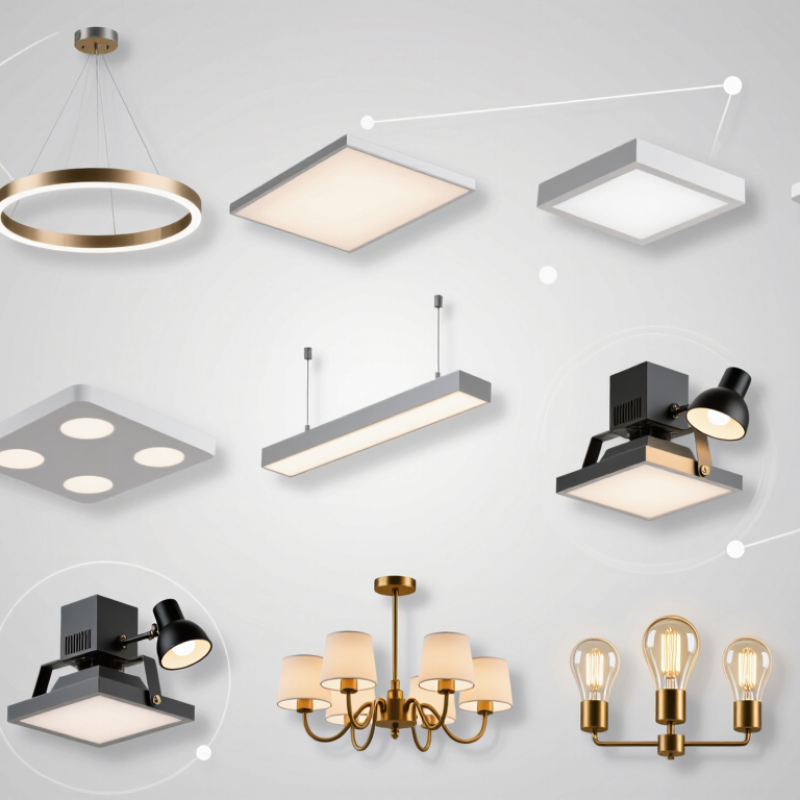
Leading lighting manufacturers compete through more than lamp output. Their portfolios typically include LED panels, high-bay fixtures, streetlights, track lights, and compact drivers. Product quality depends on details: lens design shapes glare, heat sinks protect LED performance, and driver quality affects flicker and dimming. Small parts matter.

Controls increasingly distinguish one specification from another. Occupancy sensors, daylight harvesting, tunable-white systems, and networked controls can adjust light to room use. Yet connected features add commissioning work. A clever system can frustrate installers if its interface is unclear. The U.S. Department of Energy’s Energy Saver guidance reports that LEDs use at least 75% less energy and last up to 25 times longer than incandescent lighting. These are useful benchmarks, not guarantees for every fixture or operating condition.

For global buyers, compare photometric files, color-rendering data, rated life, warranty terms, and compatibility with local control protocols. Ask for test results under stated conditions. The Illuminating Engineering Society’s LM-79 method, for example, measures electrical and photometric performance for solid-state lighting products. Good data helps compare apples with apples. It still cannot predict every installation. Dust, heat, mounting height, and maintenance access can change real-world results. A lower wattage alone is not enough.

How Global Buyers Compare Lighting Manufacturers for Their Needs

Global buyers should compare lighting manufacturers against the conditions their products will actually face. A warehouse with high ceilings needs different optics from a hotel corridor. Ask for photometric files, beam-angle options, color-rendering data, and documented test results. Numbers matter. Check whether reports match the exact product configuration, not just a similar model.

Production quality deserves the same scrutiny as product specifications. Request samples from a current production run and inspect finish, wiring, labels, and packaging. Ask how the manufacturer controls color consistency between batches and handles failed inspections. A polished sample is useful, but it does not prove every shipment will match. That distinction is easy to overlook. It is also where buyers can misjudge risk.

Compare lead times, minimum order quantities, customization costs, and warranty terms in writing. Confirm which regional safety and performance requirements apply to the destination market, and ask what evidence supports compliance. Communication matters too: clear answers about replacement parts or delayed components can reveal how practical a supplier will be after the order. No checklist removes uncertainty. Buyers should test assumptions with a pilot order before committing to a large rollout.